

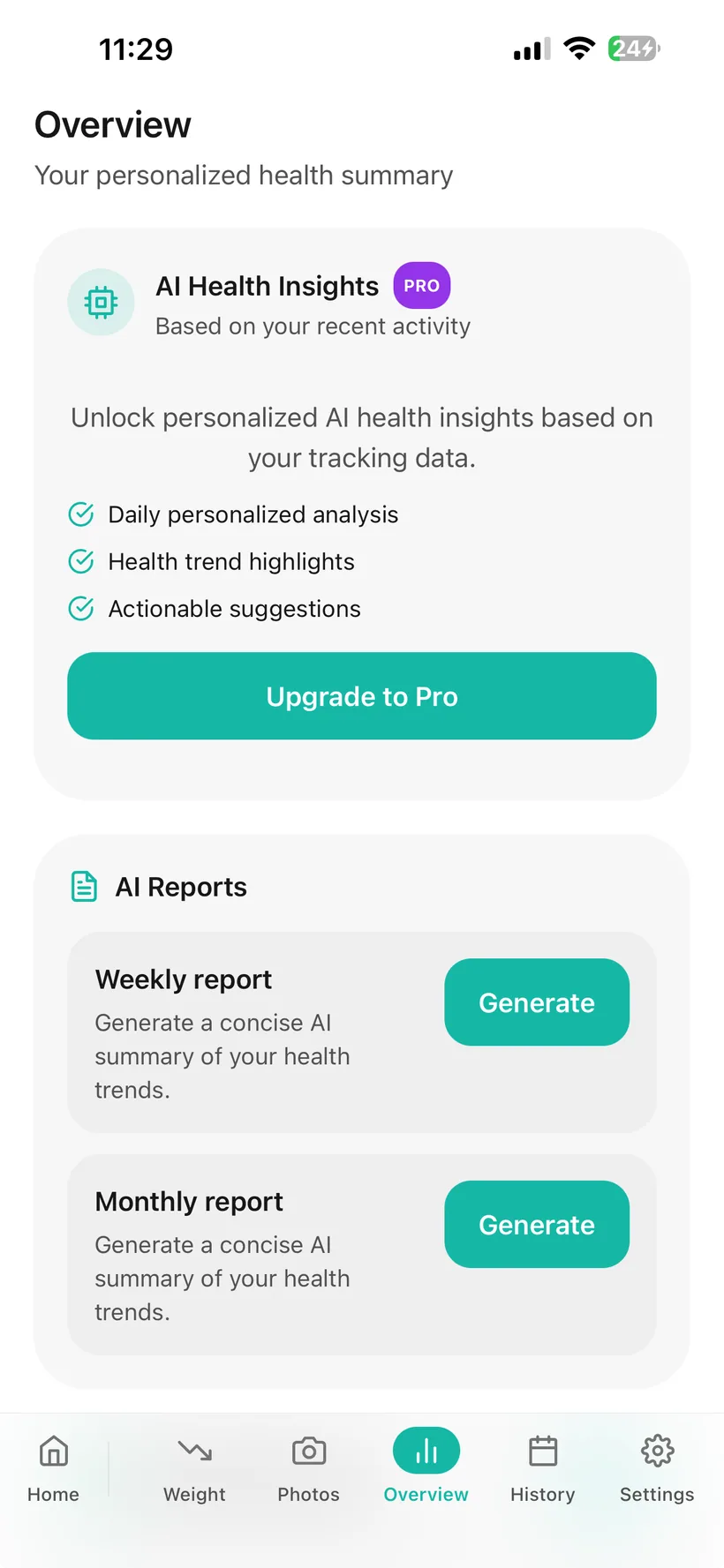
The short version
Habits AI Insights can help surface:
- patterns between tracked categories;
- changes or trends over time;
- generated suggestions based on permitted context.
The feature can use multiple Habits data categories, depending on the insight and the AI permissions you have enabled.
Three important rules
- A pattern is not proof of cause.
- A confidence label is not a medical accuracy score.
- An AI Insight does not replace professional medical advice or urgent care.
AI Insights are part of Habits Analytics
The current product reference places AI Insights in the Analytics area alongside Habits' charts and reporting features.
Habits also has non-AI charts for areas such as:
- Weight;
- Water;
- Exercise;
- Mood;
- Sleep;
- calorie intake.
AI Insights are a separate generated interpretation layer.
Habits can look for patterns across tracked categories
The current source documents correlation-style insights across health categories.
For example, a pattern might compare:
- Mood;
- Sleep;
or another combination of data the AI feature is allowed to use.
A correlation is not a cause
If two things appear together, that does not prove one caused the other.
For example:
“Mood scores were higher on days you logged Exercise.”
does not prove:
“Exercise caused the Mood change.”
Other factors may explain the pattern.
Treat correlation insights as:
something worth noticing
rather than:
a medical conclusion.
Habits can also surface changes over time
The source documents trend-style insights.
A trend insight can describe a change in recorded behavior, such as:
Hydration appearing higher or more consistent during a recent period.
A trend describes what the recorded data shows.
It does not prove:
- why the trend happened;
- that the trend is medically good or bad;
- that it will continue.
Not every Habits value has the same source
Habits can contain records that are:
- manually entered;
- logged through a tracker action;
- estimated by optional AI;
- read from a connected health source where available.
An AI Insight should be interpreted in light of the records behind it.
For example, a pattern based heavily on estimated or sparse values may be less useful than one based on consistent records.
Some AI Insights may include a suggested next step
The current product source includes a personalised recommendation-style insight.
Treat any generated recommendation as:
a general product suggestion to review
not a medical instruction.
It should not be used to decide:
- medication dose;
- medication timing changes;
- missed-dose action;
- whether symptoms are safe;
- whether medical care is needed.
Confidence reflects how much data the product has to work with
Habits' AI Insights can include a:
- Low;
- Medium;
- High;
confidence label.
The current source ties that label to data volume.
That means:
more recorded data can support a higher data-volume confidence label.
It does not mean:
the AI has medically verified the insight.
Exact thresholds
This guide does not publish exact day thresholds until the current confidence rules are made unambiguous and verified in the running build.
Logging consistency still matters
An insight can only work with the information available to Habits.
Patterns may be distorted if:
- you log some days but not others;
- you log only when something unusual happens;
- a tracker has very few entries;
- entries are estimates rather than measurements;
- your routine changed during the comparison period.
A higher data-volume confidence label does not eliminate those limitations.
A newly logged record may not immediately change an existing insight
The current product reference documents server-side caching for AI Insights.
That means an insight should not be treated as a live monitor of your current health.
If you just changed or added information, an existing insight may not immediately regenerate.
The exact data depends on the insight and the AI permissions you allow
Habits includes:
- a master AI control;
- separate AI data-category controls.
AI Insights should only use data permitted by the current AI-control model.
Learn more: How AI Privacy Controls Work in Habits →
Habits documentation specifically includes AI Insights in its PII-masking flow
The current privacy source says PII masking applies to AI Insights.
The masking filters direct identifiers such as:
- name;
- phone number;
- health IDs;
before supported insight data reaches the AI model.
Masking is not anonymity
An insight still needs relevant permitted health/tracking context.
Removing a name does not make health data anonymous automatically.
AI Insights sit inside the same AI-control system as other optional AI features
Habits includes an AI access history that records:
- time;
- data category;
- AI feature.
That can help show when an AI feature accessed a category.
AI Insights are currently included in Free and Pro
The current plan matrix includes AI Insights in:
- Free;
- Pro.
This Product Guide does not present AI Insights as a Pro-only reason to upgrade.
The quality of an insight depends on what you actually record
You do not need to use every Habits tracker.
But Habits cannot find a useful pattern between two areas if there is not enough relevant information available.
Breadth is optional.
The insight should reflect the data you chose to record and permit for AI use.
Treat an insight as something to review, not an instruction you must follow
AI can:
- misread a pattern;
- overstate a weak relationship;
- miss context;
- generate an inappropriate recommendation.
If an insight conflicts with:
- your known records;
- professional medical advice;
- your medication instructions;
do not use the AI Insight to override them.
If you have an urgent health concern, use appropriate medical/emergency services rather than waiting for an app insight.
AI Insights questions
What are Habits AI Insights?
They are optional AI-generated observations based on permitted Habits tracking data.
They can help surface patterns or trends that may be worth reviewing.
Does a correlation mean one habit caused another?
No.
Correlation shows that two recorded patterns appeared together; it does not prove cause and effect.
What does the confidence label mean?
The current product uses Low, Medium and High confidence labels based on the amount of data available.
The label is not a medical-certainty score.
Why aren't the exact confidence-day thresholds listed here?
The current source has an overlapping boundary in its documented thresholds.
Habits should publish exact thresholds only after the production rule is made unambiguous and verified.
Do Insights update immediately after every log?
Not necessarily.
The current source documents server-side caching, so an existing insight may not immediately change after a new entry.
Can AI Insights use all of my data automatically?
AI Insights should follow the Habits AI consent and permission controls.
The exact categories depend on the insight and current product mapping.
Does Habits diagnose conditions from my Insights?
No.
AI Insights should not be treated as medical diagnosis or screening.
Are AI Insights available in Free?
Yes.
The current plan matrix includes AI Insights in Free and Pro.
Does a High confidence label mean the insight is definitely correct?
No.
The current confidence system reflects data volume, not guaranteed accuracy.
Can an AI Insight tell me whether I need medical care?
Do not rely on AI Insights to make that decision.
If you have a medical concern, use appropriate professional or emergency care.
Look for patterns. Keep the interpretation in perspective.
Habits AI Insights can help surface patterns and trends from the data you choose to record and permit for AI use.
Small print:
AI Insights can be incorrect. Correlation does not prove causation. Confidence reflects available data volume, not medical certainty. Habits AI Insights are not a diagnostic or emergency-monitoring service.